Sillycan Valley
顯示具有
SiPho
標籤的文章。
顯示所有文章
顯示具有
SiPho
標籤的文章。
顯示所有文章
調製器 modulator
Notes:
調製器分成:InP, 矽光, GaAs, LiNbO3, EAM
EAM 的 modulation curve 是 DC ER
MZM 的 modulation curve 是 Vpi,輸出光強從最大變化到最小,對應的電壓變化稱為半波電壓Vpi
MZM 傳輸函數
Ref:
专访元芯光电:全国产薄膜铌酸锂调制器 响应新一代光通信发展趋势 - 讯石光通讯网-做光通讯行业的充电站! (iccsz.com)
Perturbation theory
Notes:
微擾理論的出發點是,將耦合系統看作一個受到
某種微擾的理想光波導
MRM (Micro Ring Modulator)
Notes:
優點:
compact design suitable for SiPho.
改變折射率→ 改變notch wavelength.
higher Q leads to considerable modulation.
缺點:
Phase and Amplitude 交纏在一起
Notch wavelength 需要溫度穩定.
Higher Q rings are desirable but 頻寬較低.
調變原理:Carrier injection/ depletion 進行順向偏壓/ 逆向偏壓.
Ref:
High-speed optical links | IEEE Conference Publication | IEEE Xplore
EME (Eigen Mode Expansion) solver
Notes:
適用場合:
只能模擬雙向的傳輸,不能模擬單向
傳輸路徑上有多重反射
頻域的模擬
模擬結果包含:S-parameter, filed profiles, index profiles.
範例元件:MMI, SSC, Y-branch.
Comparisons:
用FDTD 跟 EME 都可以取出被動元件的S-parameter,差異在於
FDTD 一次只能input 一個mode 在一個port,EME可以同時完成所有模擬
FDTD 可以對Broadband 進行模擬,EME 一次只能對單一頻率.
跟FDE的差別:FDE只能算uniform cross section,EME可以算non uniform cross section,並且使用FDE 對個別 cross section 找modes.
但是兩種solver, 都需要掃sweeps, 才能得到full S matrix at multiple freq. points.
Ref:
My First Simulation - Introduction - When to use EME – Ansys Optics
Multi-Mode Interference (MMI) Coupler – Ansys Optics
EME Solver analysis window overview – Ansys Optics
Multimode Interferometer (MMI)
Notes
關鍵參數:L
1xN
= 3Lpi/ (4N)
尺寸大,對於製程不敏感(相較於DC);MZM 一定用 MMI分光,因為比較穩定。
中心是一個多模波導,support a large number of modes (typ. >3),兩側放置單模波導
中心的多模波導,寬度決定1xN 的 N 大小,寬度越大,分出越多 port.
Self-imaging 原理
Lecture 6 (EM21) -- Coupled-mode devices
Simulation step
模態收斂掃描:確認模擬結果是可靠的
波長掃描:EME 是Single freq. solver, 掃波長得到S21^2 的broadband results.
Core 長度掃描:Optimal core length
Taper 寬度掃描:Optimal taper width
Ref.
AIM photonics 動畫:
Multimode Interferometer
Ansys animation:
Multi-mode interference (MMI) Coupler Simulated in Lumerical MODE
加泰隆尼亞理工大學
my_Thesis.pdf (upc.edu)
UCSB
Jesus Perez_Silicon Photonics .pdf (ucsb.edu)
Lumerical官方案例、FDTD時域有限差分法模擬學習(十三)——多模干涉耦合器(MMI)_fdtd eme是3d_子非魚icon的博客-CSDN博客
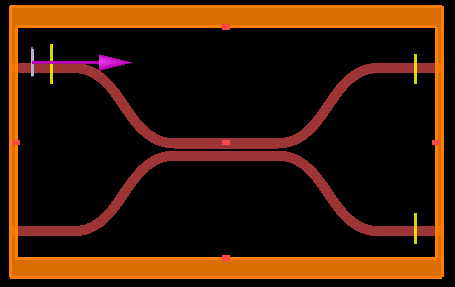
Directional coupler (DC)
Notes:
關鍵參數:Gap, length, wavelength
Coupling efficiency vs. length呈現 Sine 波的形狀
Coupling efficiency vs. wavelength 呈現 Sine 波的形狀
相比於MMI, DC的footprint較小,可以節省面積,但也由於尺寸小,製程公差較小
Ref:
AIM photonics 動畫:
Directional Coupler
較舊的文章
首頁
訂閱:
文章 (Atom)
影響因子用魚骨圖表示
Ref: 策略評析 : 魚骨圖、因果圖與問題解決思考流程 - 科技產業資訊室(iKnow) (narl.org.tw)